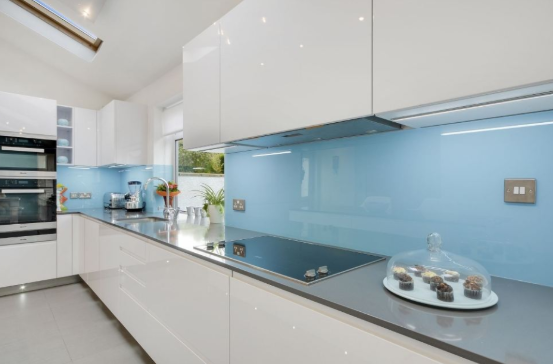
Why Glass Kitchen Splashbacks Are the One Kitchen Decision People Never Seem to Regret
Kitchen renovations generate a particular kind of buyer’s remorse that surfaces slowly. The benchtop that seemed perfect in the showroom shows water marks within months. The cabinet finish that photographed beautifully starts chipping at the corners within a year. The tile splashback that looked sharp on the mood board develops grout lines that no amount of scrubbing fully recovers. Glass kitchen splashbacks tend to sit outside this pattern — not because they are flawless, but because the specific ways they perform over years of real kitchen use align unusually well with what people actually need from that surface once the renovation excitement settles.
Grout Is a Long-Term Problem
Tiled splashbacks carry a structural flaw that becomes more apparent with every year of cooking. Grout absorbs. It absorbs steam, aerosolised oil, splattered sauce, and the residue of every cleaning product applied to it across years. Resealing slows the process. It does not stop it. The grout lines in an active cooking zone darken in a way that is cumulative and largely irreversible — each meal adding a layer that cleaning partially addresses but never fully removes. A continuous glass surface has no joints and no grout. There is simply nowhere for accumulation to begin.
The Cleaning Reality
The cleaning argument sounds like a minor lifestyle convenience until it is considered across years of daily cooking. A single wipe removes whatever landed on the surface during meal preparation — there are no textured recesses to navigate, no grout channels requiring a brush, no corners where residue packs in between thorough cleans. Glass kitchen splashbacks in households that cook seriously and frequently do not develop the background film of accumulated grease that tiled surfaces carry between deep cleans. The surface is either clean or visibly not clean. There is no ambiguous middle state where it looks acceptable but is not actually hygienic.
Colour From Behind the Glass
This is the aspect of glass splashbacks that surprises people most after installation. Paint applied to the rear surface of glass — which is how coloured splashbacks are produced — reads completely differently from paint applied to a wall or tile. The glass layer in front adds a depth and luminosity that makes the colour appear to originate from within the surface. Saturations that would feel aggressive on a painted wall sit comfortably on glass because the viewing layer softens the intensity while simultaneously amplifying the richness. Colour choices that seem bold during selection look considered and deliberate once installed — which is the opposite of how most kitchen colour decisions resolve themselves.
What Reflectivity Actually Does
Reflectivity in a kitchen splashback is not purely an aesthetic quality — it changes how the space functions under light. Glass kitchen splashbacks return both natural and artificial light back into the room rather than absorbing it. Under-cabinet lighting, which would wash into a matte tile surface and disappear, bounces off glass and contributes meaningfully to task lighting across the bench. Natural light from a nearby window multiplies rather than terminates at the splashback wall. Kitchens that feel slightly compressed with tiled surfaces frequently feel noticeably more open with glass covering the same area — not because the dimensions changed, but because the light behaviour did.
The Heat Question Answered Honestly
Toughened glass handles the thermal conditions of a residential kitchen without issue — this comes up repeatedly during consideration and the answer is consistently straightforward. The toughening process restructures the glass internally to resist thermal stress, and correctly specified splashback glass near a cooktop performs without the heat-related concerns that the question implies. The concern is reasonable. The reality is that it is already accounted for in how the product is manufactured.
Precision That Tiling Cannot Match
Glass is cut to the exact dimensions of the space. No grout line lands awkwardly at a power outlet. No tile needs to be cut around a switch in a way that produces an uneven edge. The surface fits the wall as a single continuous piece, and the result looks like it was always meant to be there rather than adapted around the constraints of a modular material.
Conclusion:
Glass kitchen splashbacks hold up against scrutiny in ways that most kitchen decisions do not. The grout problem is eliminated entirely, the cleaning burden is genuinely minimal, the colour depth is something other materials do not replicate, and the longevity is straightforward. Most kitchen renovation choices reveal their compromises within years. This one tends to reveal why it was the right decision instead.