What Your Dog Learns at a Dog Training School That Home Practice Simply Cannot Teach
There is a particular kind of frustration that hits when a dog that behaves perfectly at home completely ignores its owner the moment they step outside. The sit command disappears. The recall evaporates. The lead turns into a tug-of-war. This is not a disobedient dog — it is an undertrained one. And it is exactly the problem a proper dog training school is built around, in ways that garden practice will never fix on its own.
Obedience Needs an Audience
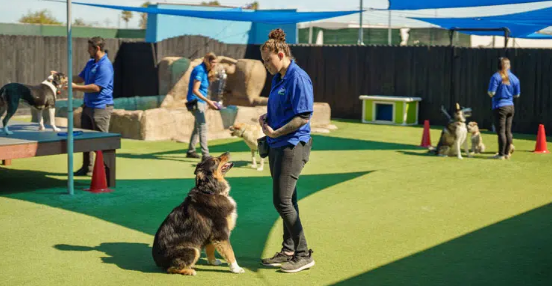
Dogs do not generalise commands the way humans do. Teaching a dog to sit in the living room trains it to sit in the living room — the dog’s brain does not automatically apply that knowledge to a busy park, a vet waiting room, or a pavement with another dog approaching from thirty metres away. This is called context-specific learning, and it is one of the most misunderstood things about canine behaviour. Structured classes work by deliberately varying the context — new location, new dogs, new smells — while the handler repeats familiar commands. That variation is what burns the behaviour in.
Timing Errors Ruin Training
The most common reason home training fails has nothing to do with the dog. It is the owner’s timing. A treat delivered three seconds after a sit does not reward the sit — it rewards whatever the dog was doing at the moment the treat arrived, which might be sniffing the floor or glancing sideways. In a dog training school, an instructor watching from outside the dynamic catches these errors in real time. They see the handler’s reward hand moving too slowly, the lead tightening fractionally before the dog reacts, and the unconscious flinch that signals anxiety to the dog before any trigger has even appeared. That outside perspective is irreplaceable. Most dogs that seem stubborn are not stubborn at all. They are confused — and the confusion usually starts with the human end of the lead.
The Socialisation Window Is Shorter Than Expected
Between roughly three and fourteen weeks, a puppy’s brain is in a critical developmental phase where new experiences are absorbed without fear. After this window closes, unfamiliar things become threatening by default rather than interesting. Many owners miss this window entirely because they are waiting for the full vaccination schedule before taking their puppy anywhere — by the time the dog is cleared to go out, the most receptive period has already passed. Reputable dog training school programmes account for this. Puppy classes held in controlled indoor environments start before the vaccination window closes, using partially vaccinated dogs and clean facilities to give puppies safe early exposure.
Reactivity Starts Long Before the Barking Does
Leash reactivity — the lunging, barking, and spinning at other dogs — rarely arrives without warning. Weeks or months earlier, there are precursor signals: a hard stare, a slight stiffening of the body, ears that go forward and stay there. Owners who have only trained at home tend to miss these early signs because they have never been taught what to look for. By the time the behaviour becomes a problem, the neural pathway is well established and significantly harder to redirect. Instructors who work with dogs daily read these signals as a matter of routine.
Breed-Specific Drives Change Everything
A Border Collie and a Basset Hound require radically different training techniques – not because one is smarter, but because they were bred for wholly distinct duties with entirely different incentive systems. Herding breeds labour for the action itself; scent hounds work for their nose. A class setting that recognises these motivations leverages them as training resources rather than battling them. Reward structure, session duration, and distraction thresholds all alter based on what a certain breed was created to achieve.
What Good Trainers Actually Watch
Experienced teachers spend less time observing the dog than most people assume. They monitor the owner’s posture, their eye contact pattern, the tightness in their shoulders, and if they are breathing. Dogs are very sensitive to human stress signals, and an anxious handler generates an anxious dog regardless of how exact the directions are. This human-behaviour component is largely missing from self-directed instruction at home.
Conclusion
Reactivity, recall issues, leash tugging, and public anxiety are the behaviours that irritate dogs the most, and they nearly invariably stem from early training gaps that were subtly allowed to develop at home. By addressing context, timing, socialisation windows, and handling skill collectively rather than separately, a dog training school addresses such gaps. The missing component for owners who have tried the treat pouches and lessons but are still having trouble is typically not effort, but rather the controlled setting where genuine learning truly stays.